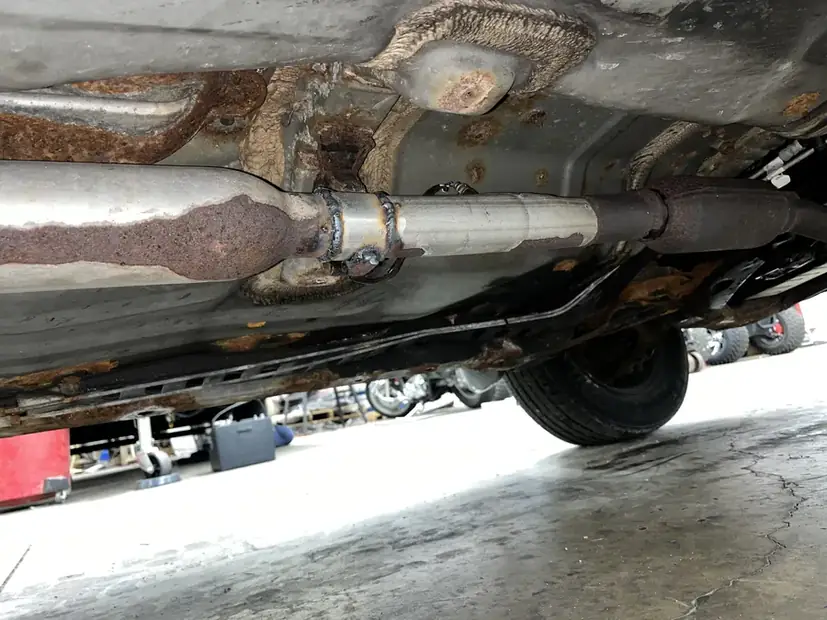
Leaks found with the system running and hot, then welded properly, before a small one turns into a manifold or converter job.
 4.9 50 reviews from Cleveland customers
Rated with the BBBArc Wheels Welding LLC, since 2023
4.9 50 reviews from Cleveland customers
Rated with the BBBArc Wheels Welding LLC, since 2023
 Black ownedIndependent shop on Cleveland's southeast side
Exhaust leaks are one of the few faults that genuinely get cheaper the earlier you deal with them. A leak at a flange starts as a tick on a cold start. Left alone, the escaping gas erodes the sealing face, the gasket goes completely, and what was a weld and a gasket becomes a flange repair or a manifold job.
There is also a safety element that gets underplayed. Exhaust gas is carbon monoxide, and a leak ahead of the cabin on a vehicle with a tired floor or a bad door seal can put it inside the car. That is not a common outcome but it is a real one and it is worth taking a persistent smell seriously.
Cold and running first, because a crack that is closed when hot is often open when cold. This is the reason a leak you can hear in the morning disappears by the time you get somewhere.
Then hot, because the opposite is also true and some joints only open once everything has expanded.
By hand and by ear along the run, at every flange, joint and seam rather than only where the noise seems loudest. Sound travels along a pipe and the loudest point is often not the source.
Manifolds get checked specifically, since a cracked manifold and a leaking manifold gasket sound similar and are very different jobs.
A tick on cold start that fades as the engine warms is usually a manifold or flange leak, opening cold and sealing as the metal expands.
A deeper drone that gets worse under load is more often a mid pipe or muffler seam.
A puffing or chuffing that follows engine speed exactly is close to the engine and worth dealing with promptly.
A rattle rather than a hiss is a heat shield or a hanger and not a leak at all, which is worth knowing before anyone quotes you for welding.
A smell inside the cabin is the one to act on now rather than at the next service.
Sealing a leak with paste or a wrap over thin metal. It buys weeks, it makes the eventual repair harder, and it hides a fault that is worth knowing about.
Usually an exhaust leak at the manifold or a flange. When the metal is cold the crack is open and you hear every exhaust pulse escaping. It quiets as things expand and seal, which is why it gets ignored.
It can be. Exhaust gas contains carbon monoxide, and a leak ahead of the cabin on a vehicle with a tired floor or door seals can put it inside the car. A persistent exhaust smell in the cabin is worth acting on now.
That is the normal case rather than the difficult one. Intermittent usually means the joint is open cold and sealed hot, so it gets checked in both states.
Leaks and damaged exhaust components are the sort of thing an inspection looks at, and a leak ahead of the converter also affects how the engine runs. Fixing it early is cheaper on both counts.
Most quotes come back the same day the shop is open. Free, no obligation, and if it cannot be repaired you will hear that straight.